

Geshe Michael Roach on the Deeper Meaning of Building Retreat Spaces
In June 2026, during the Dunhuang IR course, Geshe Michael Roach spoke again about the construction of retreat spaces.
On the surface, this may look like a building project: choosing a site, designing the structure, selecting materials, installing doors and windows, soundproofing, insect protection, fire safety.
But in Geshe-la’s teaching, a retreat space is never merely a physical room.

It carries an ancient and profound method:
a way to help people become quiet,
protect their attention,
connect with the wisdom of the classics,
and turn that wisdom into action in the real world.
A retreat space is not the goal.
It is a tool.
It helps us step away from the noise of daily life,
so we can hear a deeper direction again.
Retreat Space: A Place Where Wisdom Can Happen

Geshe-la reminded us that retreat itself is not the final destination.
It is a method.
A person needs an environment that is quiet, stable, and free from unnecessary disturbance before they can truly stop and look.
When the mind becomes quiet, it can begin to see how things happen.
And when a person begins to see how things happen, new understanding, new inspiration, and new action can naturally arise.
This is why retreat spaces are not built for escaping the world.
They are built to help people regain the strength to re-enter the world.
Dunhuang: A Place Where Light Was Once Kindled
Dunhuang is important not only because of its murals, sculptures, and history.
More importantly, for more than a thousand years, countless people came there to study, meditate, retreat, and create.
Those caves were not originally exhibition spaces.
They were living spaces of practice, learning, and innovation.
A place can retain traces.
A space can accumulate presence.
Geshe-la explained that, in the ancient tradition, when many people have practiced deeply in a place over a long period of time, those who come later may find it easier to enter a deeper state of stillness there.
This is why the plan to build retreat spaces in Dunhuang itself carries such deep meaning.
It is not simply adding a few cabins near a historic site.
It is rekindling a usable meditation cave in Dunhuang.
So that people who come to Dunhuang do not only look at murals,
but can also become quiet.
So they do not only visit history,
but can enter the method that history once carried.
Arizona: Bringing Dunhuang’s Wisdom Into the World
Dunhuang is the source.
Arizona is the first station where this wisdom begins to move outward into the world.
In the desert of Arizona, Dunhuang West is developing three kinds of retreat spaces:
Diamond Mountain · Dunhuang West Cave
for deep retreat and long-term practice.
Dragonshead · Treehouse Retreat Cabin
for short retreats and creative renewal.
Mesa · Teahouse Retreat Cabin
for training, practice, and transmission.
These spaces are not a simple copy of Dunhuang.
They are a cross-cultural continuation.
If the retreat spaces in Dunhuang allow the wisdom to return to its source and shine again,
then the retreat spaces in Arizona allow that same light to enter new land, new materials, and new communities.
The three types of spaces are not repeated versions of the same idea.
Together, they form a path:
from short-term stillness,
to deep practice,
to the training and transmission of the method.
A Good Door: Protecting Concentration

Geshe-la also mentioned an instruction from the ancient texts:
the first requirement for retreat is a good door.
It sounds simple.
But it is profound.
A good door is not only a physical door.
It means protecting one’s attention.
In retreat, the real disturbances are not always dramatic.
Insects, noise, temperature, light, phones, chores, and small interruptions can all pull the mind back from a deeper place to the surface.
This is why the construction of retreat spaces must take practical conditions seriously:
walls, doors, ventilation, soundproofing, insect protection, fire safety, and basic living needs.
These details all serve one purpose:
to help people be disturbed a little less,
and abide a little more.
In an age when concentration is constantly being fragmented,
to protect concentration is to protect creativity.
Retreat Is Not Withdrawal; It Is Training to Engage With the World
Geshe-la emphasized that retreat is not about avoiding reality.
A person does not become a bodhisattva simply by sitting alone in a room.
The real training is to come out of retreat better able to see others, help others, and serve the world.
A retreat space, then, is not a place that shuts people away.
It is more like a charging station.
It is also a training ground.
A person becomes quiet there, studies the classics, trains the mind, and receives new inspiration.
Then they bring that back into their family, company, community, and world.
A good retreat does not make a person isolated.
A good retreat makes a person gentler, clearer, stronger, and more willing to help.
Reconnecting the Classics, the Caves, and Retreat
In Geshe-la’s teaching, building retreat spaces and preserving ancient texts are not separate projects.
If the classics remain only on bookshelves, they become knowledge.
If the caves remain only in photographs, they become relics.
If retreat remains only an idea, it becomes a slogan.
The meaning of a retreat space is to reconnect these three:
to let the classics enter the human heart;
to let the caves be used again;
to let retreat become a real and workable method.
Dunhuang West is not concerned only with preserving history.
We hope to let the wisdom within history continue to illuminate the present.
The Dunhuang manuscripts,
the thousand-year cave tradition,
and the ancient method of retreat for innovation
all point toward one thing:
helping people regain wisdom and creativity through stillness.
From Dunhuang, and Back to Dunhuang
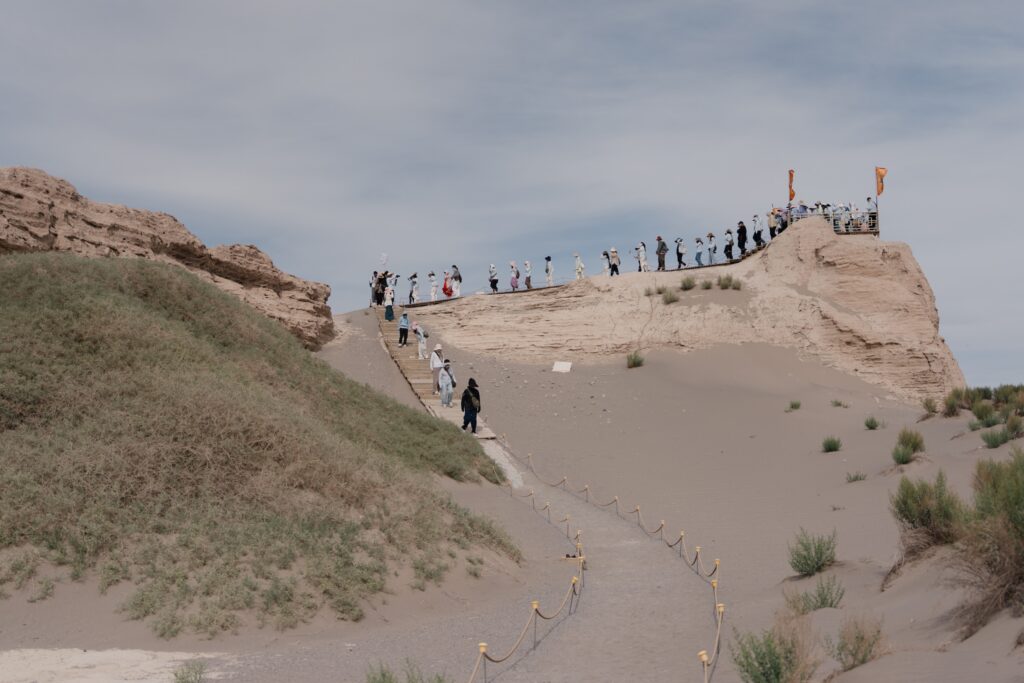
Dunhuang West is not leaving Dunhuang behind.
It is a path that begins in Dunhuang, moves into the world, and returns to Dunhuang again.
Building retreat spaces in Arizona shows that Dunhuang’s wisdom can cross geography and enter new cultures and ways of life.
Building retreat spaces in Dunhuang reminds us that the source of this wisdom can still shine today.
A cave built in the western desert shows that Dunhuang can move into the world.
A retreat space used again in Dunhuang shows that Dunhuang is still alive today.
These are not separate projects.
They are two ends of the same light.
One end returns to the source.
The other shines toward the world.
Planting Trees in the Desert, Lighting Lamps in Dunhuang

Geshe-la’s teaching helps us understand the deeper meaning of building retreat spaces.
It is not simply a building.
It is a tool.
It is a space that protects attention.
It is a bridge between the classics and the present.
It is a training ground for people who wish to serve the world.
In Arizona, we are planting trees in the desert.
In Dunhuang, we are lighting lamps in the caves.
At first, not everyone will understand.
But the first people who are willing to go ahead will plant the trees and light the lamps.
When the trees blossom and bear fruit, the world will naturally see.
When the small flames join together, Dunhuang’s wisdom will once again become a light for the world.
And on that day, what people see will not be merely a building.
They will see an ancient wisdom shining again in our time.
Dunhuang West | Let ancient wisdom continue to unfold in the contemporary world.


